

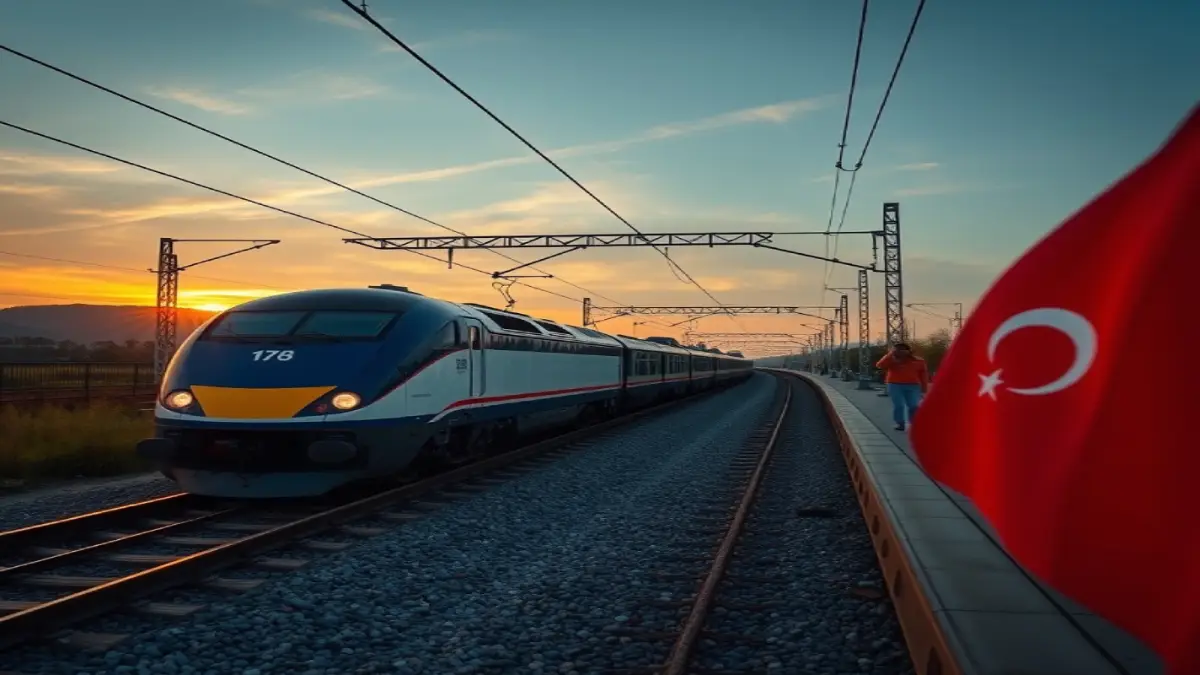
Connecting Europe to the Gulf Amidst Regional Turmoil
While global eyes are fixed on volatile maritime straits, a different kind of momentum is building on solid ground. This isn’t just about laying tracks; it’s about a “Silent Revolution” rerouting the heart of global trade. In 2026, the railway linking Istanbul to Tripoli (Lebanon) and the Gulf is no longer a historical nostalgia—it is a geopolitical necessity.
Beyond the Tracks: More Than Just a Train
The vision is simple: transforming Turkey from a “bridge” others cross into a global “control hub.” This project revives the historic corridors of the Hejaz and Baghdad railways but with a 21st-century mindset. Starting in Istanbul, the line branches within Syria toward two strategic destinations: the first breaks the Levant’s isolation through the Lebanese Port of Tripoli, and the second cuts south through the desert to link Europe with the massive consumer markets of Saudi Arabia and the UAE.
Field Progress: Who Signed and Who Started?
Behind closed doors, 2025 witnessed intense diplomatic activity. The Turkey-Syria agreement in June 2025 served as the “starting whistle,” establishing unified customs protocols and securing border paths for the first time. This was followed in September by a tripartite MoU including Jordan to ensure the line reaches the Port of Aqaba. Lebanon secured its seat in early 2026 via a technical protocol to prepare the “Aboudieh-Tripoli” link, positioning the Port of Tripoli as an indispensable international trade alternative.
On the ground, things are moving seriously:
Turkey: Has physically completed the modernization of its southern lines and is now applying the final touches to digital signaling systems at the border.
Syria: Repair workshops have begun restoring vital bridges in the Aleppo and Homs countrysides—the most complex phase of the project.
Jordan & Lebanon: Have started preparing “logistic zones” around stations, realizing that the value lies not just in the train passing through, but in the services provided around it.
The China Link: The Pulse of the Middle Corridor
This southern artery is the missing piece of the Middle Corridor. For China and East Asia, it provides a shortcut land route to the Arab world, slashing shipping times by up to 50% compared to the Suez Canal. Instead of goods only moving toward Europe, this line allows them to pivot south into the heart of the Gulf in record time.
The Language of Numbers: Why This Changes the Game
The following data illustrates the fundamental shift this line brings to regional supply chains compared to traditional maritime routes:
| Destination (From Istanbul/Europe) | Traditional Sea Route (Suez Canal) | New Rail Corridor (Levant Branch) | Time Savings |
| To Tripoli Port (Lebanon) | 5 – 7 Days | 36 – 48 Hours | ~70% |
| To Amman (Jordan) | 10 – 12 Days | 4 – 5 Days | ~60% |
| To Riyadh (Saudi Arabia) | 18 – 22 Days | 8 – 10 Days | ~55% |
| To Dubai (UAE) | 25 – 30 Days | 12 – 14 Days | ~50% |
The Great Gamble: A Peace Train Over Burning Ground
One cannot read these railway maps in isolation from the conflicts currently scorching the region. The crises in Gaza, tensions on the Lebanese border, and the Red Sea disruptions are the primary drivers—and the biggest challenges—of this project. The “Bab el-Mandeb” crisis proved that total reliance on waterways is an unsafe gamble. From here, this railway gains its legitimacy as a “land-based survival route” ensuring the flow of trade away from the threats of drones and naval operations.
The challenge remains in securing tracks through conflict zones; however, the regional consensus in 2026 is moving toward treating “train security” as a red line, where economic interests act as a brake on military escalation.
2026: The Threshold of Change, Not the Peak
We must be realistic; 2026 is not the year all the region’s economic woes disappear. It is “Hour Zero.” It is the year Turkey begins to reap the fruits of its structural stability, transitioning from a “bridge” to an economic “engine.” For the citizen, this means the beginning of a new era of cheaper goods and advanced logistic jobs.

